Pfluger Fly-By
Subscribe to my newsletter to get the latest news and updates from my office.

Press Releases
Rep. Pfluger Champions Nuclear Energy Permitting Reform Amid Growing Demand
Washington,
June 15, 2026
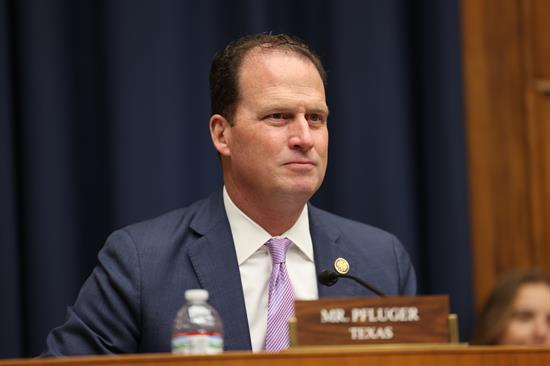
WASHINGTON, DC — Congressman August Pfluger (TX-11), participated in an Energy Subcommittee hearing titled "Nuclear Permitting Reform: Legislation to Advance Efficient Licensing," where he questioned witnesses on the future of nuclear energy. Throughout the 119th Congress, Rep. Pfluger has been a consistent and vocal champion for expanding America's nuclear energy capacity, recognizing its role in delivering reliable baseload power alongside America's abundant oil and natural gas resources. During the hearing, he advocated for innovative nuclear projects like Abilene Christian University's small molten salt reactor. He later emphasized the important role West Texas plays in leading advanced nuclear technology. Rep. Pfluger also addressed concerns about the Nuclear Regulatory Commission (NRC), citing testimony from former NRC Commissioner Jeff Merrifield that the agency is operating with integrity, renewed energy, and a strong commitment to upholding the congressionally authorized ADVANCE Act. Witnesses included Maria Korsnick, President and CEO, Nuclear Energy Institute; Jeffrey Merrifield, Chair of the Board of Directors, U.S. Nuclear Industry Council; Jeremy Harrell, Chief Executive Officer, ClearPath Action; and Kathryn Huff, Associate Professor, University of Illinois. Watch Rep. Pfluger's questioning HERE. Read Rep. Pfluger's exchange with witnesses below: Rep. Pfluger: Thank you, Mr. Chairman. I hear nothing but positive stuff about the NRC, about the way that they're doing business, about the way that they are evaluating things. I mean, Mr. Merrifield, we hear a lot from the other side of the aisle on this, like the sky is falling, but NRC seems to be doing pretty well right now. Mr. Merrifield: There actually has been an enabling of some folks who were more junior in the workforce? They've been elevated. They've shown an incredible enthusiasm about trying to reenergize the agency in alignment with the congressionally authorized ADVANCE Act. I think there's a lot of good things going on out there. I understand the concerns, and I understand some of the comments that were made early on about a rubber stamp. I've seen no evidence that the Agency is a rubber stamp. Rep. Pfluger: Doesn't seem like that's true in any way, shape, or form. I'll stick with you. I want to talk about Abilene Christians' molten salt reactor. I've been working very closely, along with other people, both sides of the aisle here on this committee. Very proud of what they're doing, and what additional things need to happen to achieve criticality on the project. Mr. Merrifield: For the sake of openness, I am an advisor to Abilene Christian University. It's a terrific school. Phil Schubert, the president, has done an extraordinary job of bringing forward a nuclear program in a university that never had one. They received assurances during the first Trump administration that there would be support for that program by the Department of Energy. Based on that, they went ahead, and they built a facility that would house their reactor. It is complete, all but the reactor itself and the control room. The issue that they're having is the availability of molten salt that was provided by the Department of Energy. They wanted to have provision of high-assay, low-enriched uranium to fuel that reactor that is underway. There is a gap, and the gap is that there is the need for roughly $50 million to provide the preparation of that material for use in the reactor. That has traditionally been a role of the university program at DOE; there's a lot of money that has been deployed for providing halo and fuel for others. They are in a catch-22. They're told, "Well, we really want to support you, but there's not enough money in the university program to do that. There are other monies available.” I think it's a crying shame. I think a small university has made a huge commitment based on government assurances, and frankly, the government's letting them down right now. Rep. Pfluger: That's exactly what we're working on. This isn't public money; this is private money that was invested here at the request of the Department of Energy. Seven or eight years ago, they did this and went through these steps. So we're going to keep working on that. I'm going to go to every... [gets interrupted] Hon. Merrifield: I think the important point is every other university research reactor out there receives fuel from the Department of Energy. Abilene Christian should be no exception. Rep. Pfluger: That's a great point. Thank you for that, Mr. Harrell; good to see you. Can you maybe discuss the importance of the Advanced Reactor Demonstration Program in helping its first-of-a-kind projects move across from the concept to deployment phase? Mr. Harrell: Thank you, Congressman, and thanks for your support for programs like it that are critical to demonstrating an initial reactor design. So ARDP ultimately catalyzed during the first term of the Trump administration, carried forward by the Biden administration, Congress continues to put the resources behind it to make it happen, is putting leading designs forward, putting them under construction, and ultimately showing their feasibility, so then we can show and learn by doing, and then ultimately build out an order book for it, and so really excited, in particular about the Texas project X Energy and Sea Drift, that's benefiting from it, and it's driving forward their fuel supply chain as well. Rep. Pfluger: Just of the reforms that are being discussed here today. What is the most important one? And after you answer, I'll ask our other two witnesses the same thing, but what is the most important one? Mr.Harrell: I would say maybe two things, so one, we have to maximize the federal taxpayer dollars that we're already putting forward. This Congress has put upwards of $3 billion behind enrichment, so I think the American Enrichment Deployment Act makes a ton of sense. We need to meet that Russia timeline. We have to stay at speed. It's a national security imperative. And then two, I think the efficient hearings bill to get rid of the mandatory requirement is a no-brainer. It takes a spot out of the process that is not necessary if there's an uncontested hearing. That's exactly the type of thing where we can reduce regulatory burden at zero sacrifice to safety. Rep. Pfluger: Thank you. That's the name of the game, Ms. Korsnick. Ms. Korsnick: Thank you. I would agree with his assessment on the American Enrichment Deployment Act. I think you know that's urgent and necessary to move forward. It's hard on the other ones; everybody does a bit of tweaking, you know, here and there. I don't know that I have a close second. The Hearing Act, that he picked, is easy; even the NRC agrees that the mandatory hearings should be changed, so it can't get easier than that. Rep. Pfluger: Ms. Huff, I ran out of time, but if you agree with those… Ms. Huff: I agree, and I think the Refuel Act is important too, because I love recycling. Rep. Pfluger: And if you'd like to follow up on anything in writing on that, we'd be happy with that. Thank you, and I yield back. |