|
Read highlights from their discussion below:
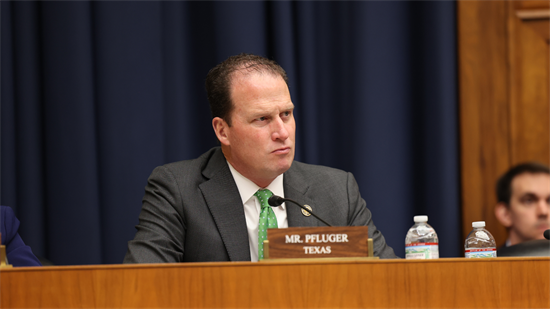
Rep. Pfluger: The discussion is so important to our future, our security, and the ability for us to continue to produce what we need, with demand growing. It's not just a timely discussion; it's something that, quite frankly, we're behind on. So thank you for that, and I strongly support every aspect of generating more power, of getting that to consumers, of competing with China, and I think we should be clear-eyed on this competition with the Chinese Communist Party that would really like to take data centers, in particular, back to the mainland of China, instead of allowing them to be here. So, yes, I think we can do all of it. And I've got a couple of questions that I'll jump into. There are a variety of ways to do this, but when lines are built, and they go through private land, I think the onus is on all of us to really tell that story about what we're doing. There are a lot of concerns back in my home district. I'm supportive of having lines transmit electricity, more electricity, but we've heard a lot of concern. And this is mostly a state-level issue in the state of Texas, so less federal interaction, but I think the Nexus here is, and I'll start with Mr. Clark, but what are the best practices for ensuring that landowners and the local communities can have a meaningful voice in transmission, siting decisions?
Tony Clark: Congressman, thank you for the question. The first thing I would say is that if I'm making recommendations to project developers, the best recommendation I would have is to make sure you have really good land agents, because that's where it starts. I've seen a number of occasions where a project will really get off track, and it's not always electric transmission lines. It can be pipelines too. But if you have land agents who aren't working well in the community and with landowners, that can be a problem. A second recommendation I would have is anything that you can do from a congressional standpoint to open up opportunities to use things like rights of way, to streamline the federal permitting process, so that project developers don't avoid multi-use federal land. I've seen many projects where it would be better to place it on the multi-use federal land and keep it off of private landowners' land, but the project developer won't choose that route. Even though it's most cost-effective, it would be better put on multi-use land, and we're not talking about wilderness areas or things like that, but they don't go that way because they don't want to trigger federal Nexus, which then triggers all sorts of federal permitting. So I think those two things will help with landowner relations and get projects done more quickly and efficiently.
Rep. Pfluger: Thank you, and I'll come back to that in just a second. Your point is well taken there. I want to go to Chairman Christie. Do you believe states are better positioned than the federal government to weigh landowner concerns and to deal with them?
Mark Christie: Absolutely, Congressman, I'll give you an example. So we had a very controversial project when I was on the Virginia Commission. It was called the trail line. It ran from Pennsylvania through West Virginia into Virginia. It was the largest regional line in PJM, and we had hundreds of people who came out to high school gyms, complaining and opposing the line. No one came out in favor of it. Hundreds came out against it, but they had their chance to speak, they had the hearings, and ultimately, we decided that the facts showed that that line was needed to avoid line overloads, which would have caused blackouts and brownouts. So the facts justified the line. We approved the line. It continued to be litigated for years. We won all the litigation. We got it built. The lesson is, state regulators are in that position to listen to the people, to give the people a chance to come out by the hundreds, literally, and speak their will. But at the end of the day, when a state regulator says the facts show this needs to be built. We had credibility that came from the fact that we were a state utility commission. Bottom line is, I don't think FERC would have that if we had said no to that line, and FERC had come in and said, Well, we're going to order you to build it anyway, I think, frankly, the political blowback would have been so fierce that the members of Congress from Virginia would have wanted to do away with backstop siting authority. And another reason is that state regulators have credibility with the people of their states, because they're there all the time, and they know what the states need. And that's why, I think, from a credibility standpoint, the states have got the credibility.
|