|
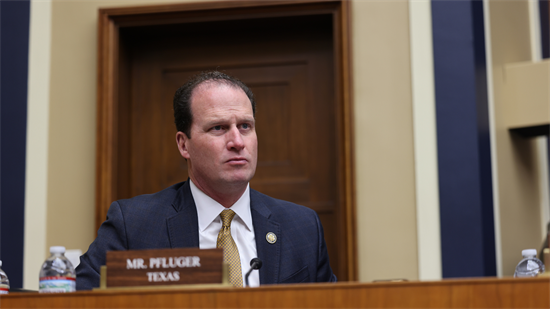
Read Rep. Pfluger's exchange with witnesses below:
Rep. Pfluger: Thank you, Mr. Chairman, and I thank the witnesses for being here. There's a company in Midland, Texas, called AST Space Mobile, and they've testified before this committee before doing some amazing work. I've followed their progress closely, visited a couple of times, and this week we had a bill, the Mystic Alert Act, that passed the House incorporating space-based direct-to-device capability into the Wireless Emergency Alert System, and space-based-broadband is exactly the type of American innovation that I think we expect, and that Republicans in the Trump Administration are working hard to accelerate, streamlining the satellite regulations is critical into making that work. And I'll start with Ms. Azocar. How will the SAT Streamlining Act directly impact companies like AST SpaceMobile, and how will the implementation of laws such as the Mystic Alerts Act be affected if we don't fix the licensing process underlying them?
Mrs. Leibin Azocar: Thank you for the question, Congressman. I just want to start by ensuring you understand that Iridium has been part of the natural disaster response since Hurricane Katrina. So while it's discussed extensively today as a direct-to-device solution, we've been doing this now for decades, and in the instance of the Texas flooding, for instance, we were used not just for critical communications during the restoration, but also drones utilize Iridium for seeing what has happened and also for search and rescue. So there are a variety of different use cases and natural disasters. The streamlining of licensing will enable more providers to provide a variety of different services to end users in the event of a natural disaster, because, as Tom has indicated, satellite service, by its nature, is resilient and redundant in a natural disaster scenario.
Rep. Pfluger: Thank you. And I'll just kind of go one step further. You know, on the deemed grant provision, if the FCC misses a deadline, then the license is automatically approved upon the applicant's written notice, but after the floods where we lost communications, you know, I'm kind of looking at the agencies missing deadlines and how that technology could have saved lives. So can you explain how the provisions necessary to give these shot clocks real teeth, and what that effect would have, just overall on safety?
Mrs. Leibin Azocar: Shot clocks are an important part of satellite streamlining, but they're not without potential consequence. So while it's beneficial to the US Space economy for licensing to occur quickly, it also needs to be deliberative and to resolve all concerns so that the licensee that receives the license, and existing licensees, have regulatory certainty to rely upon that to innovate the way that Iridium has been able to do for the last twenty-five years.
Rep. Pfluger: Thank you very much. I'll go to another topic, kind of into the novel space activities topic, and Mr. Stroup, as we consider the SAT Streamlining Act. How should we think about addressing novel space activities, and how can we complement what Chairman Carr and the FCC is already doing and what they're specifically trying to do with the Part 100 proceeding?
Mr. Stroup: Thank you for the question. There are a number of novel space activities proposed, one good example of being space data centers. And I think that from the time we started discussing satellite streamlining to today, we've seen a sea change in terms of the potential scope of the applications and the size of constellations. And so I think ensuring that there is sufficient coordination among the various organizations, governmental organizations that have an interest, and that the streamlining act accounts for the ability to be able to gather additional information from the time an application is initially submitted is going to keep going to be key to supporting the some of the novel space activities which provide a great deal of excitement and opportunity within the industry, but also create some additional challenges for the industry.
Rep. Pfluger: Any specific challenges that we should be aware of or thinking about?
Mr. Stroup: Certainly, just the sheer scope size of some of the constellations that are proposed, it raises issues with respect to the impact of using optics for connectivity. NASA filed an application, a response, and one or more of the applications that have been filed, they'd be able to monitor all of those satellites. I mean, today, one of the satellite operators has had over 3000 Manu, 300,000 maneuvers in the course of one year, if we're looking at hundreds of 1000s or a million satellites, being able to make sure that we know where all of those objects are, in order to be able to make sure that that we we ensure the safety of space is definitely one of the challenges.
Rep. Pfluger: Mr. Gold, I'm sorry, I was going to talk to you about the regulatory environment and our competition with China, and if you'd like to follow up in writing on that specifically, if we fail to get the environment right with these novel space activities, what's the risk that we're opening ourselves up to? So my time has expired, and I'll yield back, but if you'd like to follow up in writing, that'd be great. I appreciate that conversation.
Rep. Pfluger: Thank you. I yield back.
|