|
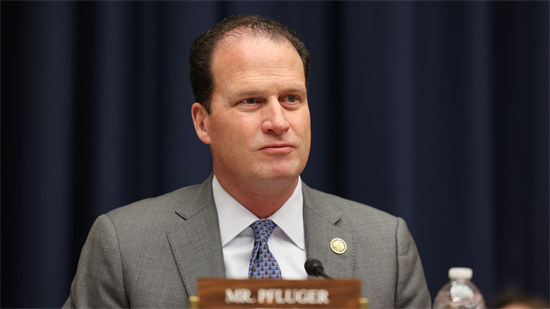
Read Rep. Pfluger's exchange with Secretary Wright below:
Rep Pfluger: Thank you, Mr. Chairman. Secretary, it's such a breath of fresh air to have an expert, somebody who knows the business of energy, and who represents all fifty states on affordable, reliable energy. And it's also nice to follow Mr. Peters from California, and I know that his heart is in the right place in wanting to work on permitting reform, which is a huge priority for us. I'll start kind of small in our district. Thank you for the work on nuclear, and you have made tremendous strides and gains, as opposed to the previous administration. You are working on this. And as you know, the project in Texas with Abilene Christian University, Natura Energy, I know that DOE has been working very closely with that. And there are a couple of benefits. Number one, it's the added dispatchable power when scaled, are going to receive from that, but number two, it's also a water issue as well, that the heat from this reactor and the technology from this reactor can help with desalination of water, especially in an area like West Texas, where water is so critical. And I just wanted to get your thoughts on that current project before going into some other ideas.
Secretary Wright: I think that reactor at Abilene Christian is a perfect example of why we are going to have a nuclear renaissance this time, and I would say at the federal government, we have a commitment that we're going to do it. We're going to be more sensible on regulation. NRC is critical in that we have great leadership at the NRC. I think they're doing great things. We are changing permit approvals in the DOE. We have used money appropriated by Congress. Thank you all, everyone here, for that to spur new uranium enrichment, new fuel fabrication in this country. So we're doing everything we can from the government end, but we have great private efforts at universities and at businesses that are trying different novel technologies, putting their own capital at risk, their time, their emotional energy into it. If you combine capital, emotional energy, and innovation with a reasonable regulatory environment, you get progress, and I am very excited about it. We're not betting on one horse or one thing, or reviving something that was old. There's so much exciting innovation going on, one right there in your district. I went to college to work on nuclear energy. I've never been more optimistic about the future of nuclear than I am today.
Rep. Pfluger: Well, thank you for that commitment. We do need the Idaho National Lab to deliver on their side of it, to really finish out that project, and I think it's going to be tremendously helpful for our country. Let me switch to the crisis that we have. And you mentioned California earlier, and I would put the northeastern United States in the same category, but I mean, California is going to end up importing from other countries because they won't allow it via pipeline or via the refineries that are actually shutting down. There are multiple refineries that are shutting down in California right now because the state has made it so tremendously difficult to work there to produce and provide for that population. So I want to tie that with the efforts that the Department of Energy is trying to do everything you possibly can, and maybe give us a sense of some of the solutions legislatively that we can be thinking about, so that there isn't a disaster in those coastal areas.
Secretary Wright: It's a serious concern about national security in California, again, massive military assets there. We supply our forward bases in the Pacific, out of the west coast of the United States, yet here we have a state, not California, that has the most expensive electricity prices. They produce meaningfully less electricity today than they did ten years ago. As does New York, as does Massachusetts. All the green energy states have expensive energy and declining output. California, one hundred years ago, a little more than 100 years ago, produced 40% of America's oil. Today, it produces 2% of American oil comes out of California. Yeah, and they consume closer to 10%, so they're just wildly dependent, not imports from other states like Texas or New Mexico; they're importing oil from Iraq and from Ecuador.
Rep. Pfluger: There's going to be a day when they [California] import more oil from Iraq than they get from the United States.
Secretary Wright: They [California] import over sixty percent of their oil from outside the United States. Over sixty percent of the oil consumed in California is imported from across the ocean, on giant tanker ships, and they import gasoline, diesel, and jet fuel refined products. They can't even make energy out of it. They had forty refineries. Now they only have seven of any size. They're not going to be able to refine enough of their own products. Some other state, like Texas, is going to have to make that quirky California gasoline blend designed to be expensive. I think that was the goal: to make it expensive.
Rep. Pfluger: Thank you, Secretary. I yield back.
|