|
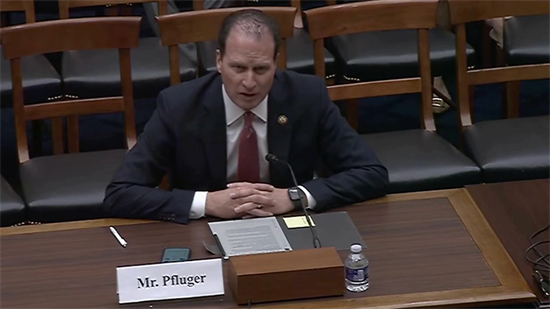
Read his remarks as delivered below:
Thank you, Chairman Rogers and Ranking Member Smith, for the opportunity to be here and to advocate for the NDAA. I served for 25 plus years, and this is an amazing bipartisan bill. And it's great to hear the bipartisan support. I hope that will actually translate into bipartisan votes in affirmative for all of the national security implications that we're facing, not just the NDAA.
I represent Goodfellow Air Force Base, 14,000 Joint Force members trained in the business of intelligence, the most incredible place for Intel training. But I'm going to go beyond Goodfellow right now.
As you know, Chairman, I flew the F-15 and the F-22 in many combat missions in the Middle East and deployments around the world. I joined an Air Force that had decisively shaped the post-Cold War world, but when I retired this past February, I left a force that remains unmatched in its capability and lethality, but is the oldest and smallest in history. It is the oldest and smallest that it's ever been.
And the facts are that the average age of Air Force aircraft has nearly tripled since the Gulf War. The Air Force fleet is roughly 60% smaller than it was during Operation Desert Storm. And for the past two decades, the Department of the Air Force has decreased budget flight hours by approximately 37%. The problem is much larger than delays in modernization; it's a lack of investment that has eroded the force over the past three decades.
Despite these constraints, the United States has conducted several complex operations over the past year that no other force on earth could have executed on a similar scale or with comparable precision. And while we are achieving extraordinary results in these operations, the uncomfortable truth is that our fleet is wearing out faster than it's being replaced, and the system is blinking red at this point.
For all of these reasons and more, the Department of the Air Force must be prioritized at this time. And I urge that the committee would reject the decades-old habit of just incrementalism, and authorize a substantial increase to the Department of the Air Force top line, even above and beyond the President's request. This funding should be fenced for procurement, for readiness recovery, and for fourth generation. And when considering the top-line budgets, I also urge that the committee clarify the Department of War's budgetary tables to reflect each department's true allocations, with a specific look at the Department of War to place all pass-through spending in the defense-wide spending account.
I would hope that the committee would direct the Secretary of the Air Force to then provide Congress with a standardized, recurring report on fleet health and on mission-capable rates, which we know are very, very low in some of our aircraft. In fact, the older ones, even the ones that I flew that were brand new in the early 2000s, including the F-22, are struggling right now, with other weapons systems struggling even more. The high-tempo deployments increase aircraft wear and reduce the air crew training opportunities, and without reliable data, the readiness gap only deepens.
The President's budget recognizes the readiness gap caused by decades of underinvestment in our force, and I am in line with the President and recognize the need to enable the Department of War to assist in securing our borders. His budget request reflects the grave reality that it will require tremendous resources to course-correct decades of decay in our national security infrastructure.
More and more conflicts abroad are creating nefarious agents that threaten the homeland, and the tactics learned by South Americans recruited during the Russia-Ukraine conflict will soon be on our doorstep, targeting our border, our infrastructure, our sovereignty, and the safety of all American citizens.
Again, I'm very thankful for this committee. I look forward to working alongside, but I have to raise the warning flags as a practitioner and as the only person in Congress who flew a fifth-generation aircraft that we are in dire, dire need of, not just a reinvestment, but a true overinvestment in the Department of the Air Force.
Again, for 30-plus years, it has been used. It's the only force, it's the only department that has been engaged in every single area of the world and in every single conflict, and it offers the President a real strategic impact that no other service can really bring to the fight like air and space power can, which is very unique. But we have to invest now. Mr. Chairman, Ranking Member, thank you for this opportunity to testify, and I yield back.
|