|
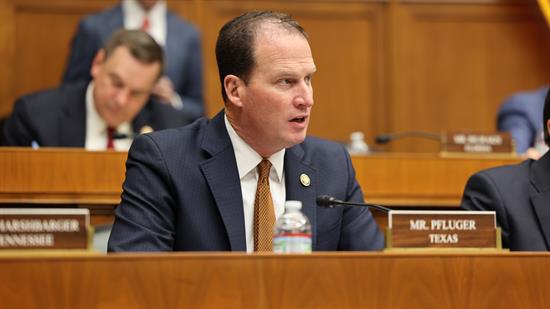
Read highlights from the exchange between Rep. Pfluger and the witnesses below:
Rep. Pfluger: So I'll start with Mr. Agnew and thank you for being here. I want to talk about who's on the network, assessing which local and state partners have access. And, if we wanted to know which folks in our area were currently accessing, how does that work? And what if we don't have all the information? Then, what do we need to do, either via statute or some other means, to know that information?
Mr. Agnew: We appreciate that question, and we continue to work with first responders to allow us to communicate who's on the network. We understand it's so important, from a mutual aid perspective, to assign mutual aid, which is when one county goes to another county to support. We are working with the authority for a process to more seamlessly get the approvals from each of the public safety agencies to say, yes, you can use my name right now. Where there are restrictions for our ability to do that is through the FCC proprietary network information, but we are working collaboratively with the authority to make sure that will happen. It's so important for public safety to know that they're on the network, so we see the value in it.
Rep. Pfluger: Do you think that's something in the reauthorization that we need to add to the statute provisions, which is kind of a transparency piece of who's on?
Mr. Agnew:I think, because both AT&T and the FirstNet authority are in agreement that this needs to be done, I don't think it's necessary to add it in, but it's something that we're working on.
Rep. Pfluger: We'll continue to look at that. Because I think that's key. Just knowing who's on the net. You know, as a fighter pilot, it's like, who's on and who are we talking to and who's not on. More importantly, right? So thank you for that. I represent AST in Midland, Texas, and proud of the work that they're doing to deliver another domain of connectivity, and I think that layer helps in remote areas, especially as we experienced during the flooding. I think the Senate held a hearing, and the relationship with AT&T and AST was raised last week. So would love to hear, you know, any details that you're willing to talk to us about with that relationship and how it relates to FirstNet, and you know, another layer of connectivity.
Mr. Agnew: Thank you for that question, Congressman. The beauty of this public-private partnership is that when AT&T makes an investment, a FirstNet user takes advantage of it, and so the investment actually is being made in AST and AT&T. Now my group works back with AT&T, and we ensure that anything that is deployed from AT&T meets the needs of first responders. So when AST goes up, when it fully launches, it will be for the first responders' version. It will have priority preemption. We talk about Push-to-Talk Mission-Critical. It'll go well beyond texting, and we're excited. We're going to open at the end of this month. We're going to open up customer sign-ups for trials specific to public safety. And it's going to launch first with public safety customers, specifically FirstNet customers, and we're more than happy to talk to any member in detail about specifically what the service will offer.
Rep. Pfluger: That's fantastic. It's another domain, especially in rural America, that will help provide that connectivity. So Sheriff, thank you for your service. I was stationed at Tyndall Air Force Base just to the east of you for many years, and I want to talk about a couple of things: the relationship between the FirstNet CEO, the board, and NTIA. My understanding is that the board and the chair provide recommendations and strategic guidance by or to the CEO, but those are not necessarily binding, and in practice, this could mean that the CEO doesn't necessarily have to, you know, follow some of the recommendations. Is that accurate, and then, as your time as board chair, have there been instances where recommendations maybe didn't necessarily get to the goal line?
Sheriff Adkinson: I think because the position of chief executive or the position of executive or the position of executive director wasn't originally contemplated, and it left that ambiguity that the executive director can and, quite frankly, in the past has again directly gone against the will of the board, I'll be specific. There was a multi-million dollar task order, which we said will be clear, not the current Executive Director, but that we said as the board, based on an executive order from the President of the United States, which we considered to be binding. FirstNet should not have been signed. That was against the will of the board, whatever rationale, whatever reason that was, it just didn't work for us.
|