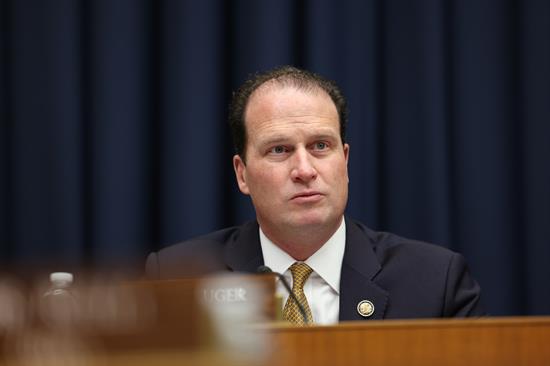
WASHINGTON, DC — Congressman August Pfluger (TX-11) questioned FERC Chairman Laura Swett on how to prevent a repeat of several failures witnessed during Winter Storm Fern during a House Energy and Commerce Energy Subcommittee hearing on oversight of the Federal Energy Regulatory Commission (FERC).
As families across the country are still digging out from Winter Storm Fern, the need for energy reliability is top of mind because when energy can't move where it's needed in unfavorable weather conditions, Americans pay the price. This storm provided a real-world stress test of the nation's electric and natural gas systems, and ensuring FERC is taking proactive measures to boost pipeline efficiency before the next storm happens is critical.
During the hearing, Rep. Pfluger pointed to the fact that during the height of the storm, states with access to reliable natural gas pipelines saw lower energy prices and fewer disruptions. Meanwhile, areas without this faced price spikes of up to 300%, forcing grid operators to burn oil and rely on imported energy just to keep the lights on. He argued that the reason for this wasn't supply, but rather a lack of pipeline capacity, highlighting his broader concern about policies that restrict pipeline development.
FERC Chairman Laura Swett agreed with Rep. Pfluger, acknowledging that areas without sufficient access to natural gas infrastructure faced unacceptably high prices and reliability challenges. She also testified that while FERC evaluates pipeline projects based on current law, which allows states to block projects outright, and action from Congress is necessary to fix this barrier that the agency cannot overcome.
Rep. Pfluger has been a consistent advocate for strengthening the nation's electric grid and expanding energy infrastructure to keep power affordable and reliable. He has championed commonsense legislation to ensure American homes stay powered and heated, especially when extreme weather puts the system to the test.
Witnesses included the Chairman of FERC, Laura V. Swett, and Commissioners of FERC, Lindsay S. See, David A. LaCerte, David Rosner, and Judy W. Chang.
Watch Rep. Pfluger's full line of questioning HEREor by clicking the image below.
Read highlights from the exchange between Rep. Pfluger and Chairman Swett below:
Rep. Pfluger: How is FERC approaching the timely permitting of interstate gas pipelines needed to serve demand and lower costs for Americans everywhere?
Chairman Swett: That's a very important question that we are all unified in looking at how we can develop more infrastructure to reduce costs for Americans, as my colleagues have said today. When it comes to specific pipeline applications that come before us, as Congress has required under the Natural Gas Act, we have to take a hard look of whether or not an individual application is required by the public convenience and necessity, and a big part of that analysis is whether the pipeline will bring economic benefits to the public, and in many cases, that would come in the form of lower costs on utility bills.
Rep. Pfluger: Let's kind of pull on that there a little bit more. You know, how is FERC working with states that block pipelines? And how are you balancing the affordability mission when you have states like New York that actually kill pipeline projects?
Chairman Swett: That is a $100 billion question. Well, effectively, under the regime that Congress has created and the Clean Water Act, states have the ability to veto a project if they do not give a certification. And that is a problem that FERC simply cannot work around, and if Congress saw fit to change that, we would be happy and ready to implement any directives.
Rep. Pfluger: Is it your belief that having those pipelines and the capacity to deliver that natural gas lowers prices?
Chairman Swett: Well, I think, as you very wisely stated at the beginning of your comments, the proof is in the pudding. The fact that areas that don't have enough gas are paying maybe 300 times what they should, as you said, is unacceptable. That is not a just and reasonable rate for Americans.