|
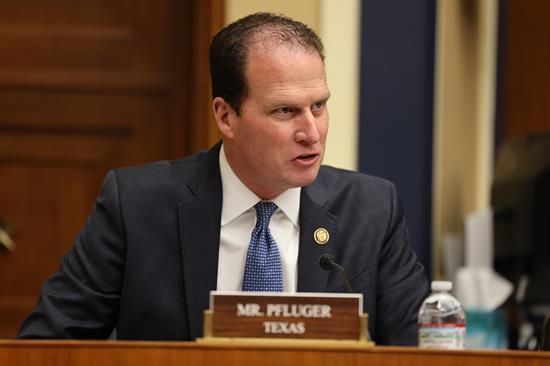
Read Rep. Pfluger's full exchange with Chairman Carr and Commissioner Trusty below:
Rep. Pfluger: Thank you, Mr. Chairman. I appreciate the work that you all are doing. It's a very important time in our country. Chairman Carr, thank you for your leadership. In 2021, you proposed a multi-year spectrum calendar that auctions specific megahertz across several bands. I asked your predecessor about issuing a spectrum calendar, which she declined, saying that the Commission cannot produce one because the spectrum auction authority had lapsed. Thankfully, as has been discussed already today, we were able, in the Working Families Tax Cut Act, to allow the FCC to auction off eight hundred megahertz of spectrum for commercial broadband use by 2034, so very excited about that. And I would ask you that, now that the Commission is in full swing and the auction authority has been restored, give us an idea of what that long-term spectrum calendar looks like, and other items that you're pursuing?
Chairman Carr: Thank you, Congressman, for the question. As you noted, we now have a concrete megahertz spectrum pipeline, and the FCC's work is well underway. We're gonna hold the first auction in a number of years, in the first half of this year, for the AWS-3 spectrum. The next step is we're finalizing rules for the upper C band, which will clear at least one hundred megahertz. We've sought comment on clearing up one hundred and eight megahertz. There's also active work underway on the seven gigahertz band, on the two point seven gigahertz band, and even on a license. Again, this month alone, we're voting to supercharge WiFi by allowing higher power devices. In addition to all of that, we are clearing the barriers in the secondary market. So the spectrum that wasn't fully loaded, that could have been sitting fallow, is moving into the hands of carriers that are loading it and lighting it up, and in increasing speed. So again, we're seeing an increase in speeds, a decrease in prices, and enhanced competition.
Rep. Pfluger: That's great to hear. Commissioner Trusty, what does that mean for national security needs, had we not passed that [Working Families Tax Cuts] and not been able to get those eight hundred megahertz out? I mean, what does this do for our competition with China's national security issues?
Commissioner Trusty: Well, it means that we're left behind. Now that we have auction authority and a long term spectrum pipeline, we can meet the growing demands of wireless services, public safety, national security, and emerging technologies, and we can fully participate in the WRC-27, which is absolutely critical to promoting American values, our economic competitiveness, and national security by having a foundation to develop a unified strategy and so on. So I really appreciate the leadership of the subcommittee.
Rep. Pfluger: You read my mind on the next question, which was WRC-27, and the steps that we're taking to support the U.S. position and be prepared for that and show some leadership. I'll give both of you guys a chance to answer on that.
Commissioner Trusty: I think this is really important, and the focus should be on aligning public and private sector interests. We also should be engaged in pre-WRC coordination with our international allies so that we can harmonize our preferred standards and technologies. And I think we need to work with Congress to ensure that we have the resources to support our technical and diplomatic representation needs. As you know, the WRC-27 is in Shanghai, China, which creates some unique security challenges for us. The State Department is taking the lead, working with the ITU and with commission staff and NTIA to resolve those challenges. But again, we need to be fully engaged in this, in this conference, so that we can win when it comes to our economic and national security.
Rep. Pfluger: That's fantastic. Chairman Carr, let me pivot just a little bit. I would like to discuss the public interest and the responsibility that you all have as Commissioners to protect the public interest. And just give you some time to explain what that means to our country for the licenses that you hand out, especially broadcast licenses?
Chairman Carr: Thank you, Congressman. So broadcasters are unique among all other distributors of information or even data. They have a license given to them by the federal government. That necessarily means the government has excluded other voices that might have wanted to use those airwaves, since they have an obligation to stand not just in their own shoes, but in the shoes of their entire community of license, and that means they have to operate differently than a cable channel, a podcast, or social media. And what's been interesting to me is that on the Democrat side, there's a lot of projection and distortion. If you go back to the Biden years, there was actual weaponization of the FCC and communications policy. As we noted, there were members of this committee who wrote letters to cable companies to pressure them to drop conservative channels simply because they were viewed, in their words, as “right-wing media outlets.” You had Democrats in Congress write letters to the FCC asking it to investigate the news activities of Sinclair broadcaster because they disagreed with the views of Sinclair. They viewed that they were right-wing, and there have been discussions, but nothing negative happened after that letter. There were 227 routine Sinclair licenses that came up for renewal or were pending during the Biden years, and all but one of those were renewed. So 226 were not renewed by the FCC. That was unprecedented. It never happened before, so Democrats put pressure, and it engendered results. What we're doing is applying the public interest standard in an even-handed way, and for people who benefited from the weaponization during the Biden years. That may feel like discrimination, but it doesn't make it so.
Rep. Pfluger: My time has expired. I yield back.
|